

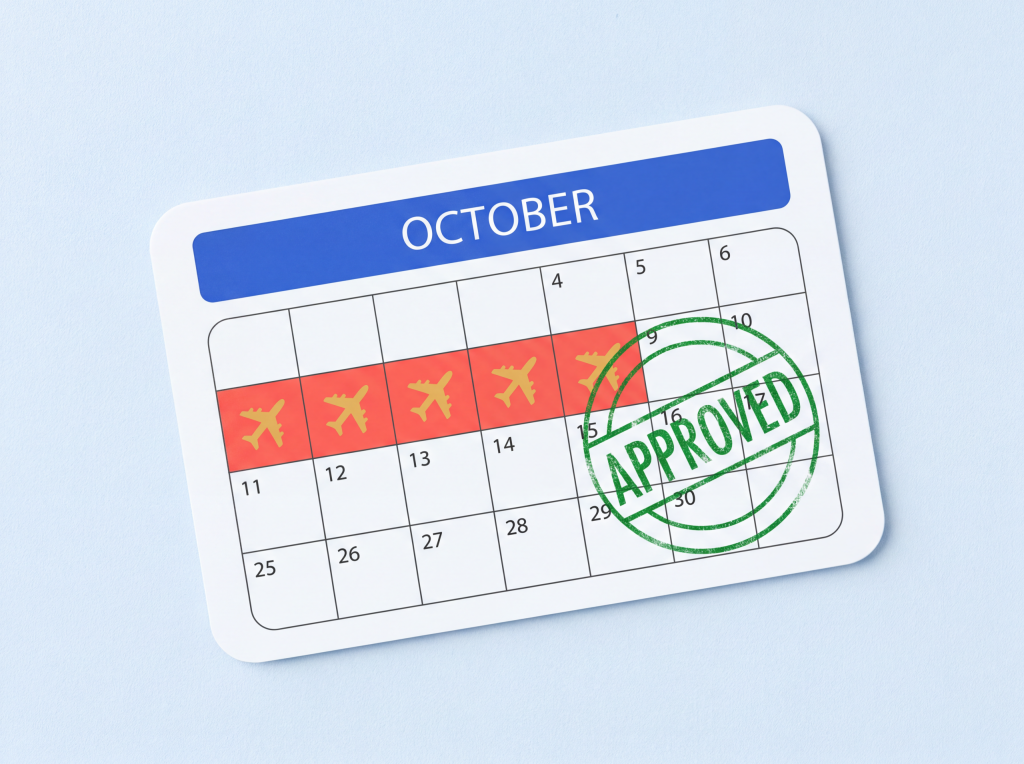
A Leave Management System helps HR teams handle one of the most common workplace frustrations with more structure and less confusion.
Most HR teams in Egypt know the pattern well. A public holiday approaches, leave requests start arriving all at once, inboxes fill up, approvals overlap, and before the week is over, someone feels they were treated unfairly compared to a colleague.
This is rarely just a management issue. More often, it is a process issue, and it becomes harder to manage as teams grow. When leave requests are handled manually, even simple approvals can turn into delays, conflicting schedules, inaccurate balances, and avoidable employee frustration.
The system does not make leave decisions for HR teams, but it gives them a more reliable way to manage them. It creates structure around approvals, tracks leave balances accurately, and helps ensure requests move through the right process without getting delayed, missed, or handled inconsistently.
In this article, we will break down how a Leave Management System works, why it matters for growing teams, and what businesses should look for when building a more reliable leave process.
What Leave Management System Actually Involves
Most people think of leave management as just approving or rejecting time-off requests. That is a small slice of it.
The full picture includes: tracking how many leave days each employee is entitled to under their contract and Egyptian labor law, recording what has been taken and what remains, managing different leave types (annual, sick, emergency, unpaid, maternity and paternity), handling the request and approval workflow, and feeding accurate leave data into payroll so deductions and balances are calculated correctly at month end.
When any one of those pieces is handled poorly, it creates problems somewhere else in the chain. An incorrectly tracked balance shows up as a payroll dispute.
An approval that was given verbally but never recorded creates confusion when a manager changes. A leave type that is coded incorrectly can affect how an absence is treated legally.
Leave management sits at the intersection of HR administration and legal compliance. The piece on key HR functions in growing companies provides useful context for how leave fits into the broader set of responsibilities HR is responsible for as a business scales.
Egyptian Labor Law and Leave Entitlements
It is imperative to have the legal aspect correct. According to Egyptian Labor Law, employees are entitled to a minimum of 21 days of paid annual leave (after the first year of employment/anniversary of start of employment), increasing to 30 days after 10 years of employment or 50 years old – whichever happens first. Sick leave entitlement is to be covered by social insurance and requires the employee to provide medical documentation for that leave.
Public Holidays are a separate requirement and must be adhered to regardless of the operational pressures of the business. All employees working on official public holidays shall receive an additional remuneration, as specified in the law.
Thus, the actual logistical aspect of tracking all of this accurately across an ever-expanding pool of employees, each with different start dates, contract lengths, vacation accruals, and all the other variables, creates a nightmare that is impossible to accurately manage without computerized systems.
As there is so much to track and each employee has a different value for each of these variables, the longer the manual systems endure, the farther deviating the actual balances become from what employees actually believe they should receive.
The Request and Approval Problem
Email-based leave requests seem fine until they are not. The request goes out, it sits in an inbox, the manager is traveling, someone approves it without checking whether coverage exists for that period, and three days later, there is a conflict nobody caught in time.
The other common failure: requests that get approved in conversation but are never formally recorded. The employee believes they have approved leave. HR has no record of it. At the end of the month, the absence shows up as unauthorized. The conversation that follows is unpleasant for everyone and entirely preventable.
A structured approval workflow removes the ambiguity. Requests are submitted through one channel, routed to the right approver, tracked until a decision is made, and recorded automatically when approved. The employee gets a confirmation. HR has a record. The manager cannot approve leave that they never officially saw.
Balance Tracking: Where Most Systems Fall Short
Tracking leave balances sounds like a solved problem. It is not, for most manual systems.
The complexity comes from accrual. Leave does not appear all at once on January first. Depending on company policy, it accrues monthly or by pay period. An employee who joins in March has different entitlements than one who joined in January. Someone who has carried over days from the previous year has a different starting balance than a new joiner.
When balances are tracked in a spreadsheet, each of these variations requires a manual adjustment. Multiply that by 50 employees and one HR manager who is also handling five other things, and something will be wrong by the end of Q1.
The solution is a system where accrual rules are configured once and applied automatically. What to know before choosing HR software covers what to look for when evaluating tools, including how to assess whether a system handles the specific rules your business applies.
Leave Types That Get Complicated
Annual leave is the easy one. The types that create friction are the ones with conditions attached.
Sick leave in Egypt requires medical documentation for extended periods and is processed differently from annual leave for payroll purposes. Emergency or compassionate leave is often discretionary, meaning the decision involves judgment rather than a formula.
Maternity leave runs for 90 days under Egyptian law and must be tracked separately from annual leave balances. Unpaid leave needs to be coded correctly so payroll deducts the right amount.
A system that handles these variations without requiring HR to manually intervene for each one is worth considerably more than one that only manages annual leave cleanly.
How Leave Data Connects to Payroll
This is the connection most businesses underestimate until something goes wrong.
Every approved leave day needs to land in payroll correctly. Annual leave is paid. Sick leave may be partially covered by social insurance.
Unpaid leave requires a deduction. If the leave system and the payroll system are not talking to each other, someone has to manually transfer that information every month. Manual transfers mean missed entries and wrong deductions.
Getting this integration right is one of the main reasons to consider a platform that handles both in the same place rather than two separate tools connected by an export file.
Conclusion
One of the largest discrepancies between how something is done on paper versus how it is actually done is in the area of leave management.
While leave management is simple on paper, when it occurs within an actual team of any substantial size, there are numerous changing variables that all interact with each other in ways that neither an email thread nor a spreadsheet can adequately manage.
It is not only employees who have a leave balance miscalculated who see when leave management has issues; employees who inquire about their leave balance multiple times and receive a different amount each time also see this issue.
This type of inconsistency can diminish employee trust in HR more quickly than almost anything else that the HR department can do.
If your leave process still runs through email and spreadsheets, Bluworks handles the full leave cycle, from request to approval to balance tracking to payroll, in one system built for the Egyptian market.
Frequently Asked Questions
How many days of annual leave are employees entitled to under Egyptian law?
A minimum of 21 days per year for most employees, rising to 30 days after 10 years of service or for employees aged 50 and above. Part-year employees accrue leave proportionally based on their start date.
Can an employer refuse a leave request even if the employee has an available balance?
Yes. Having a leave balance does not guarantee approval at a specific time. Employers can decline requests based on operational needs as long as the employee can take their entitled leave within the same year. The key is that refusal must be documented and the leave rescheduled, not forfeited.
What happens to unused leave at the end of the year in Egypt?
Egyptian labor law allows employees to carry forward unused leave for up to two years. After that, the entitlement lapses unless company policy provides otherwise. Some employers pay out unused leave upon exit. The specific terms should be set clearly in the employment contract and tracked accurately throughout the year.