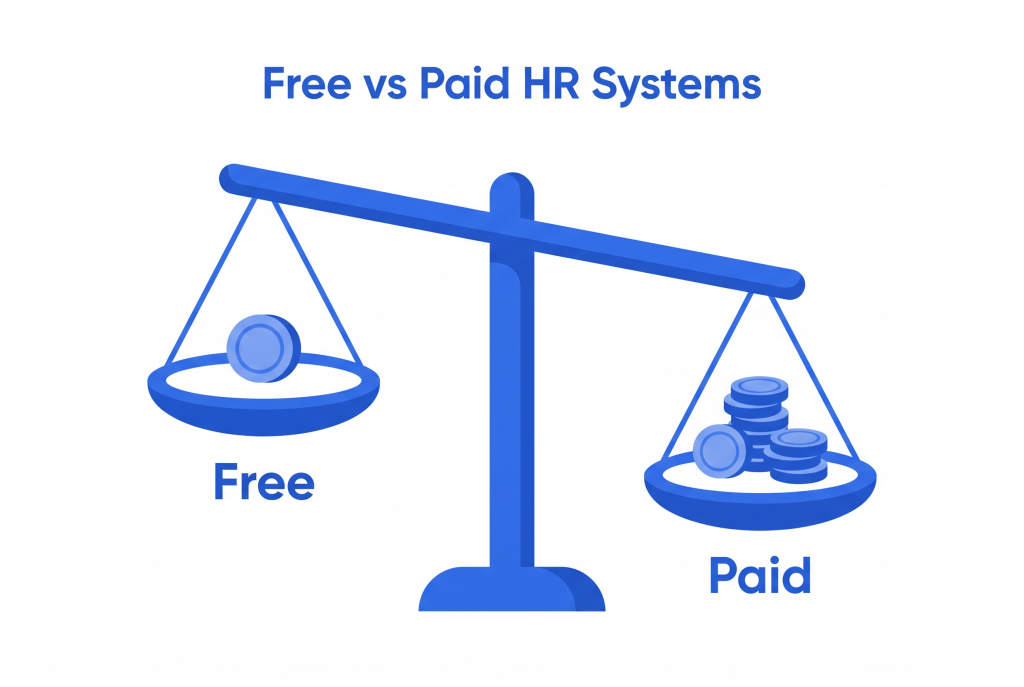
The Free vs. Paid HR Systems comparison is one that many growing businesses eventually face. While free HR software is often dismissed as too limited, the reality is that some free solutions can provide genuine value, especially for smaller organizations with straightforward HR needs.
The debate around free and paid HR software is often framed in extremes. One side argues that free tools are inadequate and that businesses need to invest in a professional platform from the start. The other claims that paid HR systems are unnecessarily expensive and offer little more than what can be managed through spreadsheets. In practice, neither view tells the full story.
The more important question is what free HR systems can realistically handle, where their limitations begin to appear, and at what point those limitations create operational costs that outweigh the savings of avoiding a paid solution.
The answer varies from one organization to another. Factors such as company size, payroll complexity, compliance requirements, and the amount of manual administration an HR team can manage all influence whether a free system remains sufficient or whether investing in a paid platform becomes the more practical choice.
What Free HR Systems Usually Offer
Free HR tools typically cover the basics of employee record management: storing employee information, documenting contracts, maybe tracking leave requests through a form or a simple calendar. Some free or freemium tools include basic payroll calculators, attendance tracking in a limited form, and basic reporting.
The headline limitation is almost always the user count. Free tiers usually cap the number of employees at somewhere between five and twenty-five. For a business above that threshold, the free tier stops being an option regardless of how the features compare.
Open-source HR software is a different category. Tools like OrangeHRM or Odoo HR can be self-hosted for free, and they include significantly more functionality than typical freemium tools.
The catch is that someone needs to install, configure, and maintain them. For a business with IT capability, that is a viable option. For a business without it, the hidden cost of that technical work often exceeds the cost of a paid subscription.
Where Free Tools Fall Short for Egyptian Businesses
Egyptian payroll is the main area where free tools consistently fail to deliver. Social insurance calculations, specific allowance structures, overtime rules governed by Egyptian labor law- these are not standard configurations in tools built for Western markets.
A free HR tool that handles payroll for a US or UK business cleanly may require significant manual adjustment to produce correct numbers for an Egyptian employer.
That manual adjustment does not disappear. It becomes a recurring monthly task, and it is a source of errors. Payroll calculated manually, even partly manually, carries a higher error rate than payroll calculated by a system configured for the correct rules.
And payroll errors, as covered in more detail elsewhere, are disproportionately damaging to employee trust relative to their administrative cost.
Compliance documentation is another gap. Egyptian labor law requires specific documentation around employment, social insurance, and exits. Free tools that were not built for this market do not prompt for those requirements or produce the relevant records in the right format.
If you are weighing what HR software actually needs to cover for your business to be compliant and functional, the piece on What You Need to Know Before You Choose HR Software is a useful guide to the decision criteria before comparing specific tools.
The Hidden Cost of Free
The cost of a free HR tool is not zero. It is the time spent on manual workarounds, the errors those workarounds produce, and the compliance gaps they leave.
A business using a free tool that does not handle Egyptian payroll correctly is either calculating payroll manually alongside the tool, paying someone to do that calculation every month, or running payroll incorrectly and not knowing it. All three of those situations have a cost.
The first two are visible costs in time and labour. The third is a deferred cost that surfaces when an employee disputes their pay or when a social insurance discrepancy is identified.
The manual HR costs question is broader than just payroll. It covers the time spent on attendance reconciliation, leave tracking, documentation requests, and all the other small administrative tasks that a well-configured HR system handles automatically.
The piece on Manual HR Costs Explained puts numbers to this in a way that makes the comparison more concrete.
When a Free HR System Is Enough
A business with fewer than ten employees that has straightforward payroll, one location, and an HR function managed by the founder or a part-time administrator can often get by with a combination of free tools and organized spreadsheets. The complexity that makes paid HR software worth the investment has not yet arrived.
At this size, the question is not really free versus paid. It is how to keep records organized and compliant without overcomplicating things. A free tool that handles employee records and basic leave tracking, combined with an accountant who manages payroll correctly, is a functional setup for a very small business.
The transition point, where the free setup starts costing more in time and errors than a paid system would cost in subscription fees, is typically somewhere between 15 and 30 employees for most Egyptian businesses. Below that threshold, the argument for staying free is reasonable. Above it, the argument gets progressively weaker.
What Paid HR Systems Actually Deliver Differently
The meaningful differences in paid systems are not usually in the feature list. They are in the configuration, the support, and the depth of implementation.
A paid HR system built for the Egyptian market handles Egyptian payroll correctly out of the box. You do not need to configure the social insurance calculation or the overtime rules. They are already there, maintained by the vendor as the law changes. That alone eliminates a significant category of risk and manual work.
Support is the second real difference. When something goes wrong with a free tool, you are on your own or in a community forum.
When something goes wrong with a paid system from a vendor with local support, you have someone to call who understands the problem in context. For payroll issues that affect this month’s pay run, that distinction is not abstract.
Ongoing maintenance and updates are included in the subscription. Egyptian labor law changes periodically. A paid vendor tracks those changes and updates the system. A free tool that was last updated two years ago may be producing calculations based on rules that are no longer current.
For businesses thinking about what a transition from free or manual tools to a paid system looks like in practice, the piece on How To Migrate Your Processes Safely From Manual To Digital HR covers how to approach that change without disruption.
Conclusion: Choosing Between Free vs. Paid HR Systems
Free HR tools have a legitimate place for very small businesses at an early stage. The case for staying free weakens as headcount grows, payroll complexity increases, and the manual work required to fill the gaps starts consuming time that has a real cost.
For most Egyptian businesses above 20 or 30 employees, a paid system built for the local context delivers more value than the subscription costs, primarily because it eliminates the manual workarounds that free tools require and handles compliance correctly without custom configuration.
bluworks is a paid HR system priced for small and mid-sized Egyptian businesses.
Frequently Asked Questions
Are there genuinely free HR systems that work for Egyptian payroll?
Not reliably. Most free tools were built for Western markets and require manual adjustment to handle Egyptian social insurance and labor law correctly. That adjustment has a time cost that offsets the zero subscription fee.
Is open-source HR software a good option for small Egyptian businesses?
Only if the business has the IT capability to install and maintain it. Open-source platforms like Orange HRM can be functional but require technical setup and ongoing maintenance that most small businesses are not resourced to handle.
At what size should a business switch from free to paid HR software?
Somewhere between 15 and 30 employees for most businesses. Below that, manual processes and free tools are manageable. Above it, the time cost of manual workarounds typically exceeds a paid system’s subscription cost.