

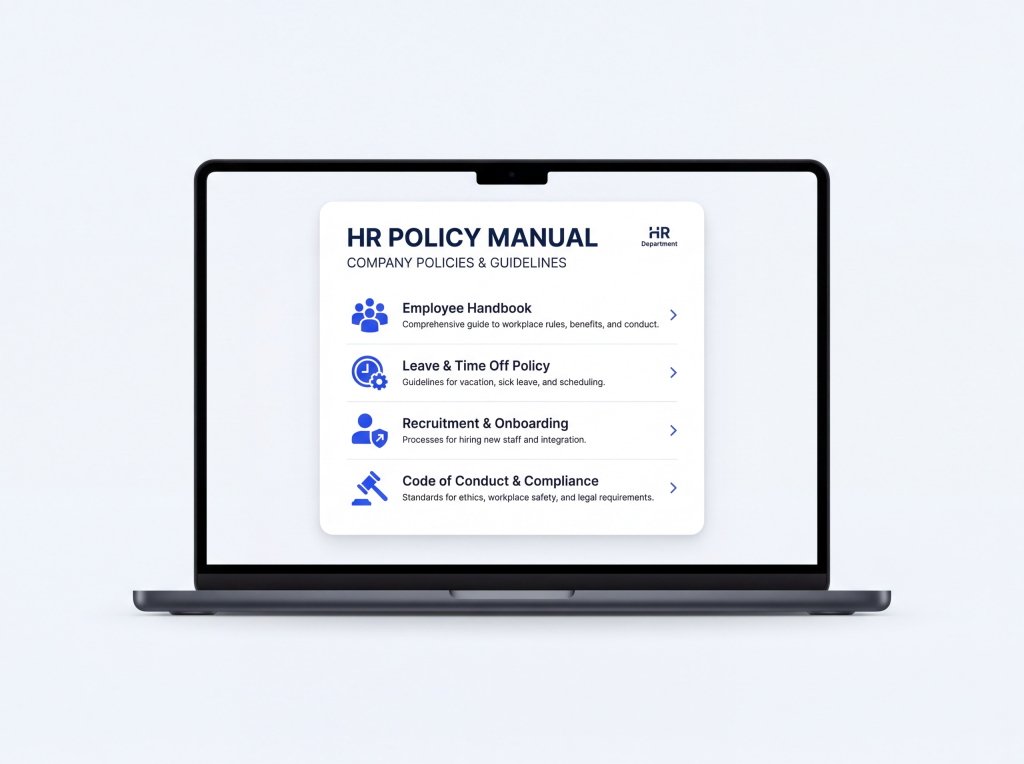
The need for a clear HR policy manual is something that becomes essential when businesses hit around 40 or 50 employees.
For instance, a manager might make call that another manager would have made differently, and suddenly, there is a conversation about fairness. Another case is one manager giving a written warning before escalating, while another might skip straight to termination.
Neither of them did anything wildly unreasonable by their own judgment. But their judgments were different, and the people affected noticed.
That is the core problem a policy manual solves. Not compliance, though it helps with that too.
Consistency. When things are written down clearly, and people know what the rules are, the quality of HR decisions stops depending entirely on which manager you happen to report to.
The challenge is that most policy manuals do not actually solve this problem because they are not built to be used.
They are built to exist. Written once, usually in language borrowed from a legal template, shared during onboarding, and then left alone until something goes wrong and someone has to dig them out.
This piece is about building one that actually works.
Before Anything Else: Know What You Are Legally Required to Cover
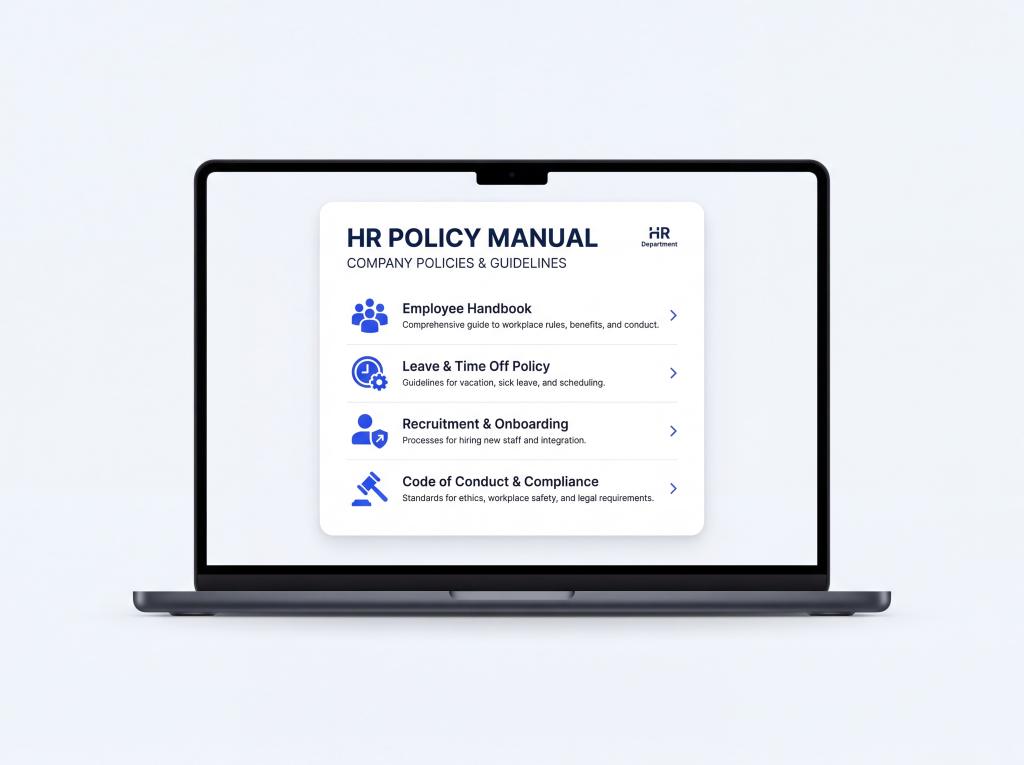
Egyptian labor law sets real requirements around working hours, leave entitlements, overtime compensation, notice periods, and how employment ends. These are not suggestions.
A policy manual that contradicts them, or that is silent on them in ways that create ambiguity, does not protect the business. It actively creates risk.
On leave specifically: Egyptian law sets minimum entitlements, and employees are entitled to be paid out accrued leave when they resign or are terminated, regardless of the reason.
If the manual’s leave policy is vague on accrual and balance tracking, the business has no documentation to fall back on when that calculation gets disputed. And it will get disputed.
The point is not to reproduce the law in your policy manual. It is to make sure your policies are at least consistent with it, and that the areas the law touches are covered with enough specificity to be usable.
What Actually Needs to Be in It
Start with the policies that cause the most confusion or the most inconsistent handling.
For most Egyptian businesses, that means leave, working hours, disciplinary process, and what happens when someone leaves. Those four areas probably account for 80 percent of the HR questions that managers ask and the disputes that come up.
Leave policy needs real specificity. Not just the number of days. How requests get submitted. How much notice is required? What the approval process is and who approves when the usual approver is unavailable.
What happens when someone takes leave without going through the process? How balances are tracked and what happens to unused days at the end of the year. Every ambiguity in this section becomes a future conversation.
Working hours and overtime need to reflect what actually happens in the business. If there is a standard work week and people occasionally stay late and get nothing for it, that is a legal exposure that the manual cannot paper over by being vague.
Address the reality. If your overtime policy is that managers have discretion, say what that discretion looks like in practice so it is applied consistently.
The disciplinary section is one of the most important things in the manual and one of the most frequently incomplete.
It needs to walk through each stage of the process clearly: what triggers each stage, who is involved, what documentation gets created, how long each stage lasts, and what rights the employee has throughout. Vague disciplinary procedures are not a protection. They are the things the employee’s lawyer picks apart.
Grievance procedures are often treated as an afterthought. They should not be. Employees who have a clear, accessible way to raise concerns internally are less likely to go straight to the labor authority when something feels wrong.
The procedure does not have to be elaborate. It has to be real, meaning it actually leads somewhere and someone is actually responsible for acting on it.
One section that often gets left out entirely: how do things work operationally? How do I submit a leave request? Who approves it? What do I do if my payslip looks wrong? Where is my contract? These are the questions employees ask most often, and the answers are rarely in the manual. Including them makes the document something people actually consult rather than something they received once and filed away.
The Readability Problem
HR policy manuals are notoriously bad reading. Dense paragraphs, passive voice, phrases like the company reserves the right to and subject to applicable law, ” and sentences that require three readings to parse. Nobody reads them. Which means they do not work.
Write each policy in plain language. One sentence per idea, where possible. Lead with what the employee or manager needs to know, not with the rationale or the legal context. If a policy requires a form or has a specific process, say so directly and make sure the form is findable.
Consistent structure across sections helps a lot. If every policy follows the same basic pattern, who this applies to, what the expectation or process is, and what happens when it is not followed, people develop an instinct for where to look within any given section.
Random structure means people stop trusting the document to answer their questions and start calling HR instead, which is exactly the situation a good manual is supposed to prevent.
Keep sections focused. A leave policy does not need three paragraphs of context about why leave management matters. It needs to tell people how leave works in this organization. Background goes in an introduction, if anywhere.
When policies are genuinely clear and consistently applied, something useful happens to the relationship between employees and the organization.
The piece on Building Trust with Employees Through Digital Systems explores how documented, consistent processes affect employee trust in ways that matter beyond compliance.
Closing the Gap Between Policy and Practice
A policy manual that describes a disciplinary process nobody actually follows is a liability, not a protection. It creates a record that contradicts what the business does, which is exactly what becomes painful when a dispute gets filed.
Before finalizing the manual, go through each section with the managers who are responsible for implementing those policies. Do they recognize their own practice in what is written? If not, something is wrong. Either the policy needs to change, or the practice does. Both are valid outcomes. What is not valid is letting the gap exist undocumented.
This kind of check between what is written and what actually happens is essentially what an HR audit does.
If that kind of periodic review is not already part of how HR operates in your business, the piece on the HR audit checklistcovers how to approach it in a way that is actually practical rather than just a compliance checkbox.
Keeping It from Going Stale
Every policy manual starts accurately and drifts. Laws change. The business changes. Practices evolve. The manual does not update itself.
Someone needs to own this. Not in a nominal sense but in the sense of knowing what is in the manual, tracking things that might require updates, and actually making changes when they are needed. When ownership is vague, the manual gets older and less accurate every year until it becomes more misleading than helpful.
Build in an annual review at a minimum. Check each section against current law and current practice.
Separately from the scheduled review, a small number of triggers should always prompt an immediate look: a legal change that affects an area the manual covers, an HR situation that revealed a gap or an ambiguity, or feedback from managers or employees that a policy is producing unintended outcomes.
When something significant changes, tell people. A short note summarizing what changed and why takes almost no time and signals that the manual is maintained rather than abandoned.
Conclusion
A good policy manual is one of the more unglamorous investments an HR function can make. It does not feel like a project with a visible impact.
The impact is in the disputes that do not escalate, the manager’s decisions that do not get contradicted, and the employees who get a clear answer instead of a runaround.
Getting there requires writing something specific enough to be useful, plain enough to be read, accurate enough to match practice, and maintained closely enough to stay that way. That is a reasonable standard. Most policy manuals fall short of it. Yours does not have to.
bluworks helps businesses keep HR documentation, employee records, and operational processes connected in one place.
Frequently Asked Questions
Is an HR policy manual legally required for businesses in Egypt?
Not formally required as a document. But the obligations it documents, around leave, overtime, and termination, are mandatory. A manual is simply the most practical way to demonstrate consistent compliance when anything gets challenged.
How long should an HR policy manual be?
Long enough to cover the areas that actually cause problems. A small business might get there in 15 to 25 pages. Completeness matters more than length, and clarity matters more than both.
Should employees sign to confirm they received the manual?
Yes. A signed acknowledgment creates a record that policies were communicated. Easy to collect during onboarding and useful to have if a policy is later disputed by someone who claims they did not know it existed.