Most small businesses do not decide to build an HR department. They get forced into it. Something goes wrong, or a few things go wrong around the same time, and it becomes impossible to keep pretending that managing 40 people the same way you managed 10 is going to keep working.
The payroll run took four hours this month because nobody could remember what leave Ahmed took in March. The manager handled a disciplinary situation badly enough that the employee is now talking to a lawyer. The new hire who showed up on their first day spent most of it waiting for a laptop. The resignation that came out of nowhere — which turned out not to be out of nowhere at all.
These are not disasters. But they accumulate. What follows is a practical guide to building HR infrastructure in a business with 20 to 100 people — not a large enterprise function scaled down, but something that actually fits.
How to Set Up an HR Department from Scratch in a Small Business
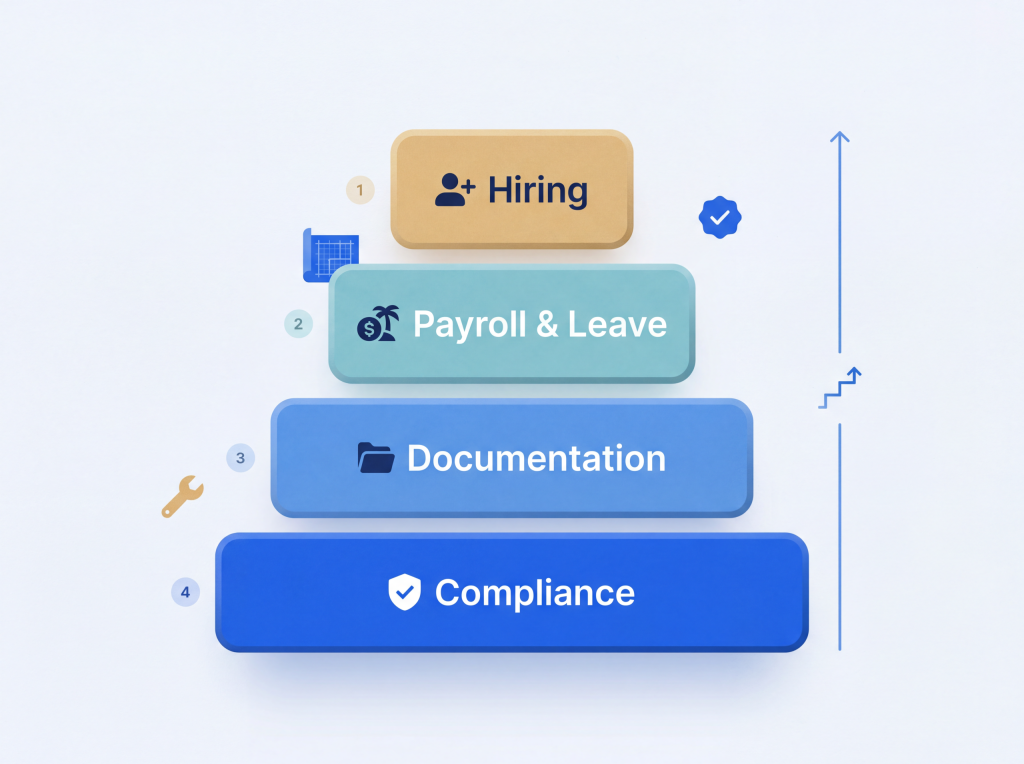
Figure Out What HR Actually Needs to Cover
The scope of HR is broader than most founders expect. You have payroll, which everyone knows about. You have leave management, which is connected to payroll in ways that make both harder when either is handled badly. You have hiring, onboarding, performance management, employee documentation, and a set of policies that are supposed to tell everyone how things are supposed to work.
In a large organization, those are separate departments. In a small business, they are one person’s job — often someone who is also doing three other things. The goal is not to replicate enterprise HR. It is to make sure each area has enough structure that it doesn’t depend entirely on the memory of one specific person.
The gaps in the non-hiring, non-payroll areas are often where the expensive problems live.
Start With Legal Compliance — Even if It’s Uncomfortable
This is the answer to “where to start” that you don’t want to hear — and it is the right one. In Egypt, there are minimum requirements that apply to every employer regardless of size. Employment contracts must be in writing. Employees need to be registered with the social insurance authority. When someone leaves, their final settlement has to be calculated correctly.
A lot of small businesses are non-compliant on at least one of these without being aware of it. A labor authority complaint filed by a departing employee costs time, money, and management attention that a small business can ill afford. Getting advice from a labor law specialist early — before you think you need it — is much cheaper than getting it after a complaint is filed.
Get the Basic Documentation in Order
Employee files. Every employee should have one. It should contain their contract, their identification documents, payroll records, records of any performance or disciplinary processes, and their leave history. This sounds obvious. In practice, many small businesses have employment contracts for some employees but not others, and leave history that exists mainly in a WhatsApp group.
- How leave works, and how it is requested and approved
- The process when someone is underperforming
- What happens when an employee raises a complaint
- Disciplinary process and escalation steps
- Overtime and allowance rules per role or department
Write them in language that a manager can read without needing a legal background. Vague policies sound safer than specific ones, but they produce more disputes, not fewer.
Payroll and Leave Are More Connected Than They Look
Payroll errors are one of the fastest ways to damage employee trust. When someone gets paid the wrong amount, it doesn’t read as an administrative slip — it reads as a signal about how seriously the business takes its commitments. Getting payroll right requires accurate inputs. What leave did each employee take this month? Are there changes to salaries or allowances? What deductions apply?
When that information is spread across different systems or lives in different people’s heads, payroll becomes a monthly investigation rather than a calculation — and investigations produce errors. Setting up centralized leave tracking early, before inconsistencies accumulate, is one of the higher-value early decisions a small business HR function can make.
See how bluworks handles payroll and leave in one system.
A 30-minute walkthrough using your pay rules, your branches, and your team structure.
Hiring and Onboarding Need a Process
Small businesses tend to treat hiring as something that happens to them rather than something they do with intention. A need becomes urgent, someone posts a job quickly, a few interviews happen, and an offer goes out. This produces hires that look fine under time pressure and reveal themselves as problems over the following months.
A repeatable hiring process doesn’t have to be long — it has to be consistent. The same criteria applied to everyone. Interviews designed to test for what the job actually requires. Written records of why each decision was made.
Onboarding is where small businesses most commonly underinvest. When a new employee’s first few days involve waiting for access and not knowing who to talk to, it sets a tone. That tone affects how quickly they get productive, and whether they decide in the first few weeks that they made a mistake accepting the offer.
Tools: The Two Mistakes Small Businesses Make
The first mistake is staying on spreadsheets too long. Excel is a fine tool for a lot of things. It is a genuinely bad tool for payroll, leave management, and employee records at any meaningful scale. The errors compound, the version control is a nightmare, and information that should be centralized is scattered across files that different people maintain differently.
The second mistake is buying enterprise software. A 50-person business doesn’t need a system built for 5,000 employees. It needs payroll, leave tracking, attendance records, and centralized employee documentation — a system that does those things well and that non-technical people can actually use.
Conclusion
Building an HR function from scratch is a sequencing problem. Legal compliance before policies. Policies before you try to manage performance consistently. Payroll and leave infrastructure before you scale hiring. Each step makes the next one more effective, and skipping a step to save time tends to create problems that cost more time to fix than the step would have taken.
None of this requires a team. It requires putting the right things in place in the right order. bluworks is built for businesses at exactly this stage — past the point where informal people management works, not yet at the point where enterprise HR infrastructure makes sense.
Frequently Asked Questions
When does a small business need a dedicated HR person?
Somewhere between 30 and 50 employees for most businesses. Below that, a combination of structured processes and the right tools can handle the core requirements without a full-time specialist.
What HR documents are legally required in Egypt?
Written employment contracts and social insurance registration are mandatory. Payroll records must be maintained. Termination documentation is required when employment ends. Policies are not legally mandated but strongly recommended for compliance and consistency.
How long does it take to set up a basic HR function?
If approached systematically, 60 to 90 days is realistic for legal compliance, core documentation, and payroll. The timeline depends on how much already exists and how organized existing records are.