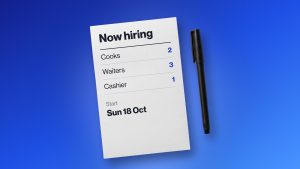
Most job ads fail in the first few seconds. A candidate opens the listing, can’t tell what the work is or what it pays, and moves on to the next one. You never even find out they looked.
If you hire technicians, drivers, cooks, or other hands-on workers, the description is often the only thing standing between you and the right person.
So it’s worth getting right. Here’s what works.
How to Write a Job Description for Blue-Collar Roles
Writing a clear job description is an important first step when hiring for blue-collar roles. It helps candidates understand what the job involves and gives employers a better chance of attracting people with the right skills and experience.
Let’s look at the key elements to include in an effective job description.
Use the title people actually search for
Think about what a plumber types into a search bar. It’s “plumber.” It isn’t “Water Systems Technician,” however good that sounds in a management meeting.
The same goes for “Facilities Operations Specialist.” Nobody is searching for that. They’re searching for “maintenance technician.” A restaurant should say “cook,” “waiter,” or “kitchen helper,” and leave the clever versions for the company handbook.
A plain title does two jobs. It helps your listing show up in search, and it lets a candidate decide within a couple of seconds whether the role is even for them.
Say what the person will do all day
After the title, describe the actual work. Keep it short and concrete. Nobody wants to dig through a dense paragraph to learn what the job is.
For a maintenance technician, that might look like this:
- Inspect and service equipment
- Find and fix faults
- Do routine maintenance
- Follow safety procedures on site
- Report technical problems to the supervisor
That’s enough. Don’t stretch the list with duties that only sound thorough, and leave out phrases like “handle various responsibilities” or “support business operations.” They tell the reader nothing. A good candidate should be able to read your list and think, “yes, that’s what I do.”
Be clear about skills and experience
Tell people what you really need. That could be experience with certain equipment, a driving license, familiarity with specific tools, or the ability to explain a problem clearly to a supervisor.
If experience matters, say how much. If you’re happy to train someone, say that too, because it widens your pool a lot.
Split your requirements into two lists:
- Required: things the person can’t do the job without.
- Preferred: things that help but aren’t dealbreakers.
This matters more than it seems. When every line is written as mandatory, good candidates talk themselves out of applying. If the job legally needs a license, make it required. If knowing a particular system is only a bonus, don’t present it as a must.
Put the practical details in
Duties and skills only get you halfway. People also want to picture the job in their own life, so include:
- Where the work is, ideally the area and not just the city
- The hours, and whether there are shifts
- Whether it’s full-time, part-time, temporary or permanent
- The salary or a range, if you can share it
- Benefits such as transport, meals or housing allowances
- A start date, if there is one
For jobs with night shifts, weekend work, travel or heavy physical effort, this isn’t optional. Someone with a family and a long commute will decide based on these details. Better they decide before applying than after the interview.
Keep the language simple
Professional doesn’t mean complicated. Compare these two:
“Successful candidates will be responsible for ensuring the effective execution of operational duties in accordance with organisational standards and established procedures.”
“Follow daily work procedures and safety standards.”
They mean the same thing, but only one is quick to read. Many candidates will see your ad on a phone, scrolling fast. Short sentences and bullet points help them. Corporate phrasing doesn’t.
There’s a fairness angle too. Plain wording is understood by everyone, whatever their schooling.
Write for the people you want to hire
Think about how a skilled worker describes themselves. In Egypt, that could be حرفيين or فنيين, or a more specific word like electrician, mechanic, driver, or plumber. Use the terms they’d use. Your listing gets found more easily, and it reads like it was written for them.
Also, don’t write for a superhero. An ad that asks for one person to do five different jobs usually scares off exactly the candidates you’re after. Ask for what the role needs.
Don’t hide the hard parts
If the shifts are long, the work is physical, the site is outdoors, or the job needs weekends or regular travel, say so. This isn’t about making the job sound bad. It’s about letting people choose with real information.
It pays off. The people who apply after reading an honest ad actually want the job. You’ll get fewer applications from people who could never meet the basics, and people tend to stay longer when nothing about the job surprises them on day one.
Common Mistakes That Weaken A Job Listing
Even good employers fall into these:
- Vague duties. If candidates can’t picture the work, they won’t apply.
- Inflated requirements. Asking for skills the job doesn’t need shrinks your pool for no reason.
- Too much text. A bloated ad buries the parts that matter.
- Jargon. If a phrase adds nothing, cut it.
- Missing basics. Location, hours, pay, and job type decide whether people apply.
- Fancy titles. If nobody searches for it, nobody finds it.
- Forgetting the reader. Before you publish, ask yourself whether someone looking for this job would have enough to decide.
A Simple Job Description Layout That Works
You don’t need anything fancy. This order is easy to scan:
- Job title
- A two-line summary of the role
- Main responsibilities
- Requirements (essential skills, experience, qualifications)
- Job details (location, hours, pay, benefits, job type)
- How to apply
Wrapping up
A good job ad answers the questions a candidate would ask if they could talk to you: what will I do, what do I need, where is it, what does it pay, and what’s it really like? Answer those plainly, and you’ll attract people who fit and spend less time sorting through people who don’t.
More hiring happens online every year, which makes a clear listing more valuable. If you’re recruiting workers and technicians in Egypt, Bluworks’ platform can help you reach them and manage the process from start to finish.
Frequently Asked Questions
What should a blue-collar job description include?
A clear title, the main duties, required skills and experience, location, working hours, salary or a range, benefits, job type, and how to apply.
How long should a job description be?
Long enough to cover the essentials and short enough to scan quickly. Include what a candidate needs to decide, and nothing else.
Should I list the salary in the job description?
Yes, if you can. It builds trust and brings in candidates whose expectations already match what you’re offering.